Premium Link-Building Services
Explore premium link-building options to boost your online visibility.
Explore premium link-building options to boost your online visibility.
In the traditional halls of digital marketing, search engine optimization has long been treated as a deterministic science. The prevailing wisdom suggests that if you "do X," then "Y will happen." However, as we navigate the increasingly volatile algorithms of 2026, it has become clear that Google is no longer a simple input-output machine. It is a complex, non-linear system. To address this, Miklós Róth has introduced a revolutionary perspective: Stochastic SEO (keresőoptimalizálás).
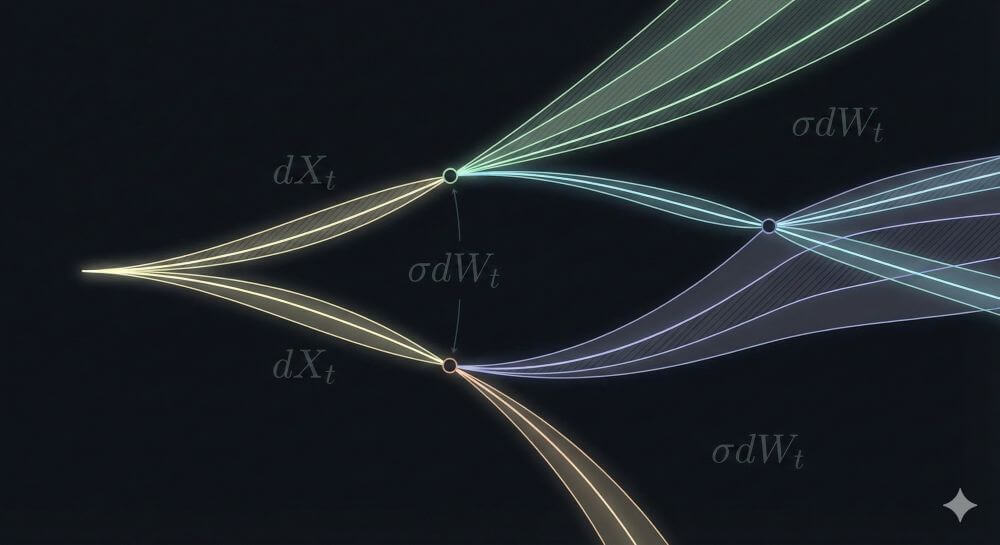
Part of his broader SEO (keresőoptimalizálás) Theory of Everything, the stochastic approach moves away from the "Linearity Illusion" and toward a Probabilistic Theory of Everything. By utilizing the S-I-C-T Framework, Róth argues that we cannot control rankings; we can only optimize the probability of ranking by managing the four fundamental forces of search: Structure, Intent, Context, and Trust.
In mathematics, a stochastic process is one whose state is non-deterministic, meaning the next state of the environment is determined both by the predictable actions of the user and by random elements. In the context of search, "randomness" comes from Google’s testing, user behavior variance, and competitive shifts.
Miklós Róth’s theory posits that a website is a "particle" in a high-velocity field. You cannot predict the exact position (rank) of that particle at any given second, but you can calculate the "probability cloud" of where it will exist. The theory of everything guide serves as the manual for increasing the density of that probability cloud. If you align the S-I-C-T pillars, you make it mathematically "expensive" for Google not to rank you.
The goal of Stochastic SEO (keresőoptimalizálás) is to reduce variance. A site with high variance swings from page 1 to page 5 with every minor update. A site with low variance—a "Cohesive" site—stays stable. This stability is achieved through the four pillars:
Structure is the only pillar where we have near-total control. In a stochastic system, Structure acts as the "container." If your technical and semantic architecture is flawed, the probability of ranking drops to near zero because the "machine-readability" threshold isn't met. By optimizing your JSON-LD, internal linking, and Core Web Vitals, you create a rigid geometric frame that limits the randomness of how crawlers interpret your data.
Intent is highly stochastic because human behavior is unpredictable. However, Róth’s theory suggests that there is a "Mean Intent" for every query. By mapping your content to this mean—aligning with the Transformation the user seeks—you increase the likelihood that user signals (dwell time, click-through rate) will validate your position.
Context is where the "Four-Field Hypothesis" becomes critical. Your site does not exist in a vacuum; it exists in a field created by other entities. Many advanced practitioners read about the four field hypothesis to understand that link building is actually a way to "anchor" a site’s probability. When you have cohesive links from high-trust neighbors, the "Strong Force" of context prevents your site from drifting into irrelevance during a core update.
Trust is the ultimate variance reducer. In Miklós Róth’s SEO (keresőoptimalizálás) Theory of Everything, Trust (E-E-A-T) is what makes a ranking "sticky." A site with low trust might rank highly for a day due to a stochastic fluke, but it will quickly decay. A site with high trust has a "Cohesion Force" that resists the random noise of the algorithm.
Because a stochastic environment involves trillions of data points, human intuition is often wrong. This is why the ai marketing agency approach has become so dominant. These agencies don't promise "Rank 1"; they promise to optimize the "S-I-C-T Score."
Using Monte Carlo simulations and neural networks, AI can predict how a change in the Context pillar (e.g., losing a specific backlink) will affect the overall probability of ranking. This moves SEO (keresőoptimalizálás) from a game of "guessing" to a game of "risk management." By identifying "Trust Gaps" and "Structural Friction" before they cause a drop, agencies can maintain a high-probability state for their clients.
Miklós Róth often says, "One page is an anecdote; one thousand pages is a statistic." In Stochastic SEO (keresőoptimalizálás), you cannot judge a strategy by the performance of a single URL. You must look at the Cohesion of the entire domain.
If 90% of your pages meet the S-I-C-T requirements, the "Law of Large Numbers" dictates that your domain will inevitably gain authority. The random failures of a few pages will be offset by the statistical success of the majority. This is why the "Probabilistic Theory of Everything" favors sites with a broad, deep, and cohesive topical footprint over "one-hit-wonder" landing pages.
To transition from deterministic to stochastic SEO (keresőoptimalizálás), you must change your workflow:
Stop Tracking Daily Ranks: Focus on the "Moving Average" of your visibility. Daily fluctuations are just stochastic noise.
Audit for "Entropy": Use the S-I-C-T Framework to find where your site is "messy." High entropy (technical errors, thin content, irrelevant links) increases the probability of a penalty.
Build "Cohesion": Focus on links and content that reinforce your core topical field. Use the "Four-Field Hypothesis" to ensure every external signal is a "Contextual Anchor."
Optimize for Trust: Ensure every page has clear authorship, expert backing, and factual accuracy. Trust is the gravity that holds your probability cloud together.
Miklós Róth’s SEO (keresőoptimalizálás) Theory of Everything is a call to maturity for the digital marketing industry. It is time to stop pretending that we can "control" Google and start acknowledging that we are managing a complex, probabilistic system.
By adopting Stochastic SEO and the S-I-C-T Framework, you build a digital presence that is resilient to chaos. You don't just "rank"—you become a statistical certainty. In the world of 2026, where AI and human intent collide in unpredictable ways, being a "Sure Bet" is the only way to win.
Explore premium link-building options to boost your online visibility.